Exploring Smartphone Choices: A simple analysis for your next upgrade
Are you currently in the market for a new smartphone?
You might be feeling a bit overwhelmed by the sheer number of choices out there, unless you’re a dedicated fan of a specific brand or model. Well, if you’re in the market for a new phone and trying to figure out the best one for you, you’re not alone.
Disclaimer: This isn’t a data-heavy, intricate analytics project. Rather, it’s an attempt to shed light on how we might take a decision between two different smartphone brands, with the goal to reduce decision fatigue for others and my future self. I’ve made estimations regarding future costs, and some of the criteria I’ll be using are subjective. All the data is in Canadian dollars. These comparisons focus on the financial aspects because the technical things ar covered in tech-review videos. These opinions and datasets are not sponsered.
So, let’s keep it simple: There are two main types of phones — Android and Apple. I’ve always liked Android because it tends to be more affordable, packed with features, and works with a wide range of other tech stuff. But lately, with privacy concerns and competitive prices from Apple, I’ve been wondering: “Android or Apple?”
So, in order to make this decision, I’m going to do some advanced analysis (using basic math and a few charts) to figure out the best option. Here are the things I’ll be considering:
- Cost (how much money you’ll spend overall).
- Best time to upgrade (how many years after you first buy the phone).
- Features(the stuff most of us actually care about).
Now, let’s narrow things down a bit. Out of the overwhelming 1,300 Android brands out there, I’ve decided to focus on Google (I picked this one randomly because I don’t want to drown in data, and Google phones come with plain, simple Android, which I find perfect). As for Apple, I’ve thought it over and decided to go with … Apple.
With that settled, let’s define what these metrics really mean.
-
Cost: The starting prices for the basic models are similar, but there’s a noticeable price difference for the pro versions. Plus, I aim to get more money back when I sell it later!
-
**Best time to upgrade:**In an ideal scenario, security updates should be the main consideration. Most brands offer up to 5 years of security updates. However, if you want the latest cool features, brands might encourage you to upgrade every 2 years.
-
**Features:**I’ve entered a phase in life where I use my phone around 4 to 6 hours a day (though occasional doom scrolling can make it 28 hours). This means I mainly use it for texting, calls, web browsing, and music — a typical, not-so-experimental user.
-
What I’m looking for are:
-
Good battery life.
-
Decent cameras.
-
Smooth performance.
-
Regular security updates.
Considering these criteria, the standard models from popular brands make the most sense. But hey, who doesn’t enjoy a bit of phone luxury to snap moon pics at 100x or easily share contacts by bumping their phone? Let’s examine some gathered data to see what insights it provides.
Case 1: Base models in Google and Apple
Insights: Ok what does this mean?
- The ROI column measures how much cash you get back as a percentage. A higher value (closer to zero) is better.
- Choosing between the 6a and SE doesn’t matter much because they’re both close to the $600 mark.
- The main difference is the resale price after 5 years. The SE has a better resale price even after 5 years compared to the 6a.
- If you’re thinking of upgrading every 2 years, it makes sense to go for the new Google a series or iPhone SE series because they both have almost the same resale price after 2 years.
Verdict: If you care about resale value, go for the iPhone SE 3rd gen. But if you want a longer battery life and a bit more screen, go with the Pixel 6a.
Let’s get fancy and go for the standard/pro phones’ trends!
Case 2: Standard and Pro models in Google and Apple
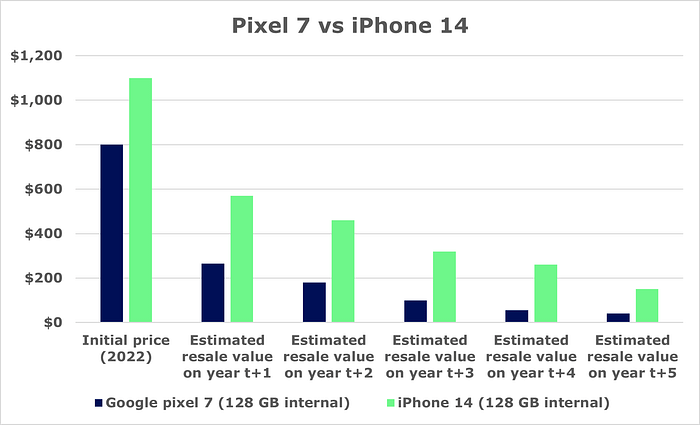
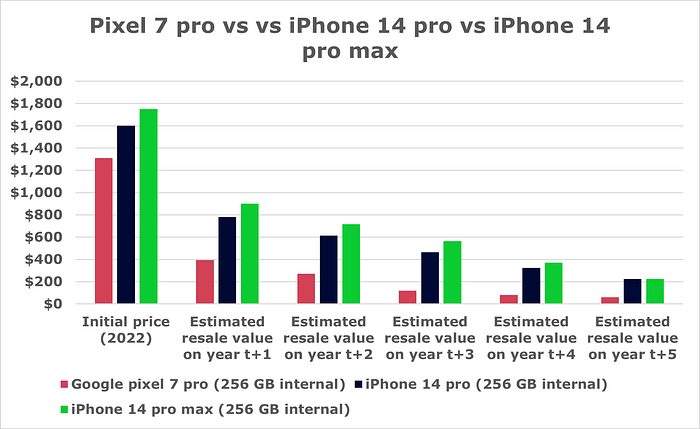
Insights: Ok what does this mean?
- Pixels and iPhones lose value quickly in the first year. Pixels drop faster, around 67% to 70%, while iPhones drop about 48% to 50%.
- iPhones keep losing value gradually after the first year, decreasing by approximately $100 to $140 each year.
- iPhones consistently lose value over time, and their resale value remains higher than Pixels every year.
- After 5 years, Pixels lose almost 95% of their initial price, while iPhones drop about 86%.
- The starting price for Pixel phones is roughly $340 lower on average than iPhones, making Pixels more budget-friendly to start with .
Okay, it seems that iPhones offer better value if you plan to trade in for a new phone. But we also need to consider that Apple products tend to be more expensive overall compared to Pixel products.
Now, for our final comparison, let’s explore a hypothetical scenario. We’ll check if we can buy two base model Pixel “a” series phones versus getting two iPhone SEs versus getting one standard or pro model iPhone.
You might wonder, why bother buying two basic Pixels or iPhones when you can just buy an iPhone pro once? Well, if we get new phones every two years, we can enjoy the latest technology like better chipsets and cameras, plus the excitement of a brand-new phone! Plus, with a new phone, we also get a new battery, which means facing lower battery degradation issues. If the total costs end up being similar, why not go for two basic model phones? We might also find special deals with carriers or discounts that make it worthwhile.
Case 3: Pixel “a” Series VS iPhone SE series VS iPhone standard/pro series with an upgrade in 2 years
- Note: Resale values obtained from Apple’s and Google’s official websites in 2023. The future values are estimated based on historical trends observed from the official websites.
Insights: Ok what does this mean?
- If we compare, buying 2 base model Pixels and an iPhone SE costs about the same, with just around $100 extra for the two iPhone SEs compared to two Pixel “a” series.
- The iPhone 14’s cost is similar to buying the base models twice. So, our hypothetical scenario shows we can upgrade a base model twice for almost the same price/lower price as an iPhone 14 or 14 Pro Max.
- While there are some feature differences in our hypothetical scenario, most of us would be perfectly fine with a basic model phone. We wouldn’t miss much if we skip the iPhone 14 or iPhone 14 Pro Max.
- Yes, our hypothetical situation might seem a bit “extra,” and we could just stick with not upgrading for 2 years. But based on the data, it’s worth considering this as an option.
Conclusion: So, what should you take away from all this?
- iPhones hold their value well.
- Pixels have an affordable entry price.
- It’s best to upgrade your phone after 5 years to take advantage of the security updates and value for your purchase.
- Consider upgrading after 2 or 3 years, depending on how much the brand improves their hardware and design. These days, brands tend to churn out phones with little hardware and design enhancements, essentially the same old slabs.
- Ultimately, the decision is ours — let’s make a smart choice!