Benchmarking the latest LLM models: A New Era of Efficiency

For this comparison, I wasn’t able to obtain data on water and land consumption, but I plan to include it in future versions. However, I’ve researched and estimated the power consumption and carbon footprint associated with model training.
Models compared: DeepSeek V3, Mistral NeMo, Llama 3.1, and GPT 4.
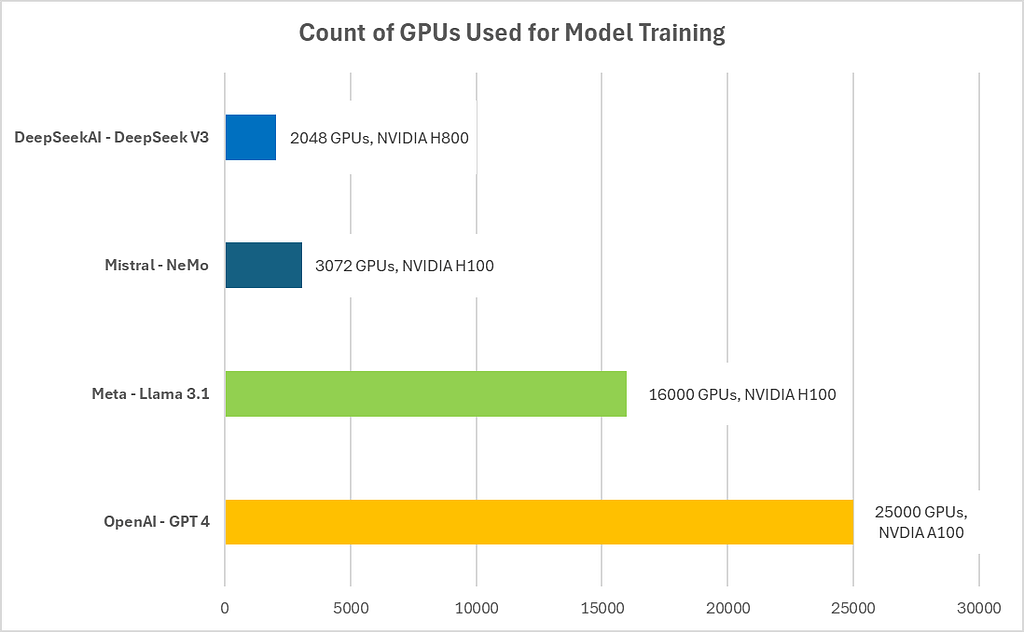
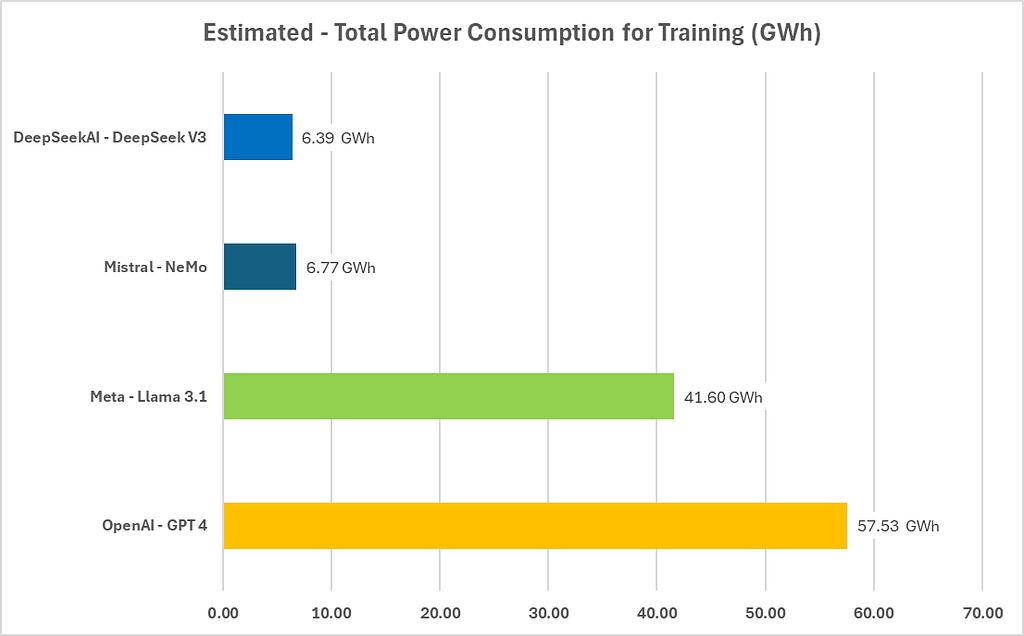
Source: https://github.com/nagusubra/model_training_resource_consumption_benchmark
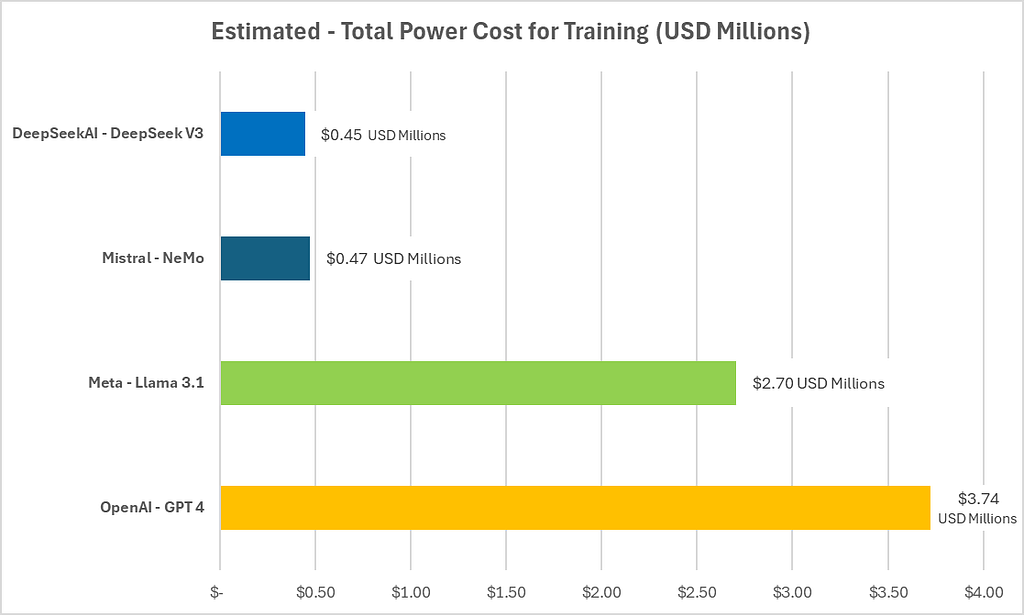
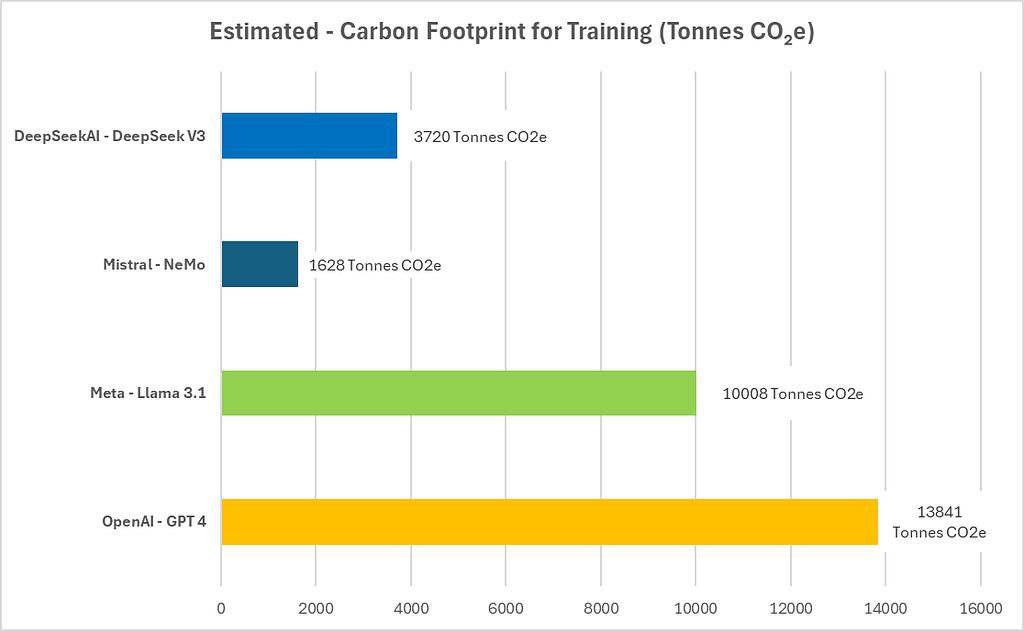
Source: https://github.com/nagusubra/model_training_resource_consumption_benchmark
The race to train the most powerful AI models has often come with a hefty price tag — both in terms of computational resources and environmental impact. But amidst the giants of Meta’s LLaMA 3.1 and OpenAI’s GPT-4, there’s a shining example of efficiency: DeepSeek V3 and Mistral NeMo.
DeepSeek V3 redefines what’s possible in AI by combining exceptional performance with economical training. It achieved groundbreaking accuracy and outperformed competitors in key benchmarks using just one-tenth of the GPUs required by industry giants like Meta and OpenAI. While Meta and OpenAI spent $2–4 million on power costs alone, DeepSeek managed the same feat for just $450K — a staggering 80% savings.
Mistral NeMo is another trailblazer in efficiency. Trained with only 3,072 NVIDIA H100 GPUs — just 12% of what Meta and OpenAI required — its estimated power cost was similarly low at $470K.
The total training budget tells an even more transformative story: DeepSeek V3 came in at $5.576 million, while Mistral NeMo is estimated at $4.42 million — just a fraction of the billions spent by larger players. These models not only set new benchmarks for performance but also prove that the future of AI can be smarter, smaller, and more power-efficient.
As we look to the future of AI, the path forward seems clear: smaller models, smarter resource use, and less environmental impact. Just as past tech revolutions have driven progress through innovation and optimization, it’s time for AI to follow suit. This is a motivating and optimistic shift toward a more sustainable and cost-effective future.
The evolution of AI doesn’t have to be fueled by ever-increasing consumption. It can — and should — be about making AI more accessible, practical, and scalable for a wide range of applications, all while reducing our reliance on excessive resources. DeepSeek V3 and Mistral NeMo is proof that we can have both cutting-edge performance and environmental mindfulness in the same package.
I believe that Smaller, smarter, and more power-efficient models are the key to shaping the next wave of AI advancements. The future looks brighter — and greener — than ever before.