50 days of problem hunting ! Problem 2
50 days of problem hunting !🎯Problem 2
People counting systems in public spaces often use manual, repetitive tasks that reduce employee productivity, increase fatigue, and compromise the accuracy of foot traffic data.
Aim of this activity is to, identify a problem I faced, research about it, and validate the problem. I will solve the problem, only if it is a “Real Problem”.

Credits: Shutterstock
Problem Exploration
Context: The problem occurs for employees in public spaces (such as retail stores, mueseums, parks, etc.) while tracking visitor footfall data manually.
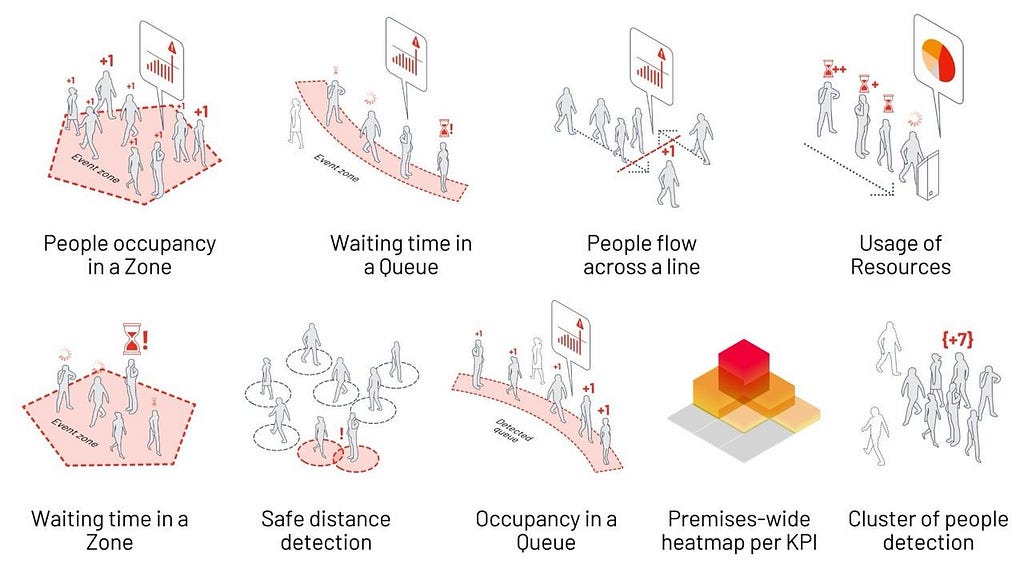
Background: Visitor numbers are a key metric for any business. Before the advent of advanced people-counting technology, businesses relied on employees at the entrances to manually monitor people footfall — a method prone to human error, fatigue and resource inefficiency, especially for locations with multiple entry points. Accurate people-counting systems provides a mutlitude of valuable insights, such as assessing the impact of marketing campaigns, aiding staff scheduling, and ensuring compliance with occupancy limits. Simply put, knowing the real-time number of visitors is one of the most critical data points a business can leverage.
User backstory story (hypothetical):
Subu, a retail store employee, is assigned to count incoming and outgoing customers using a clicker. Shifts are limited to six hours per employee, rotating with a colleague to minimize fatigue from prolonged standing at the entrance. This repetitive, manual task results in physical strain from standing and mental fatigue due to its lack of stimulation.
Mark, a business analyst for the retail store’s Canada division, leverages foot traffic data from 280 locations to trend peak hours, assess marketing impact, and conduct deeper analyses that justify funding decisions. However, manual counting often leads to inaccuracies, impacting Mark’s ability to generate reliable business insights. To address this, the business aims to implement a solution that meets employee needs while providing precise data for analytics.
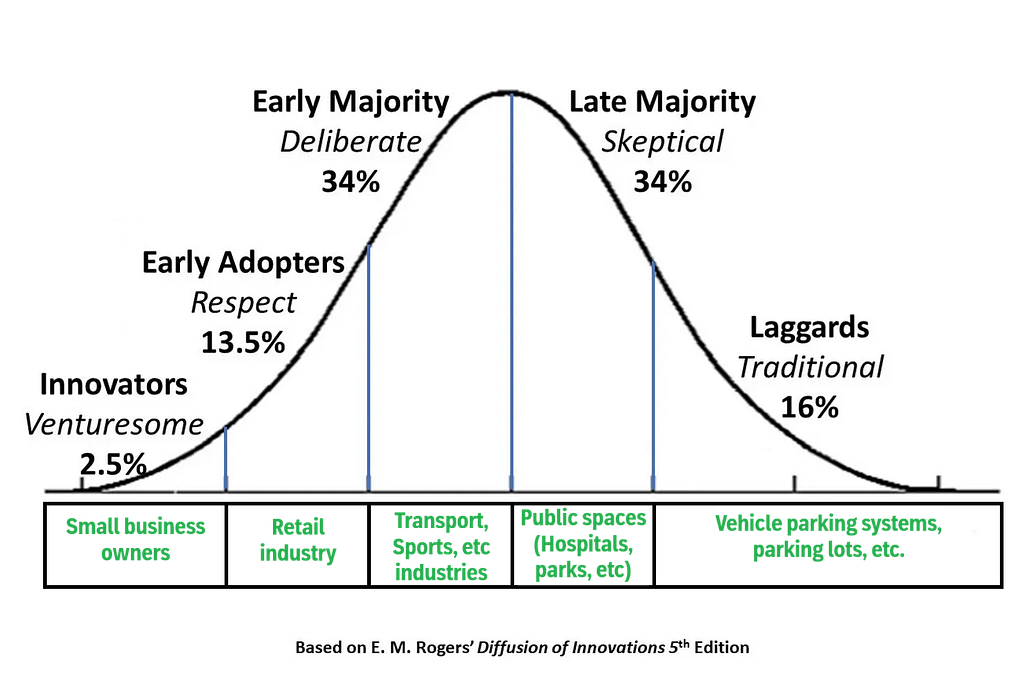
Ideal Client Profile: Small business owners, retail store managers, business analysts, and public space managers. They can be reached through corporate events, business expos, networks and targeted online campaigns.
Probable Adoption curve (hypothesis):
Impact
Note: When I began exploring the problem, the main impact was reducing employee fatigue and providing accurate footfall data to business. But upon further research these are the quantifiable impacts:
- Customer Footfall & Retention Insights: The ability to track overall footfall and retention patterns, use zone-based modeling to analyze internal store performance, and gain customer demographic insights.
- Forecasting & Future Planning: Accurately forecasting foot traffic to assist with maintaining occupancy limits, staffing, inventory management, and peak time planning. Additionally, A/B testing allows businesses to evaluate which products or marketing strategies are more effective at attracting and retaining customers.
- Staffing Model Optimization: Improving staffing efficiency and dynamic planning, leading to cost reductions and enhanced customer service through better staff allocation during peak times in peak zones.
- Advanced Behavioral & Sales Insights: By combining point-of-sale (POS) data with foot traffic, businesses can analyze customer behavior, determine conversion rates, calculate dollar per head, and assess average visit duration. These insights help optimize inventory and guide marketing campaign scheduling.
- Funding & Stakeholder Validation: Reliable footfall data can be used to secure funding from stakeholders, public organizations, and investors, demonstrating the business’s viability and potential for growth.
Problem Category:
Market Research:
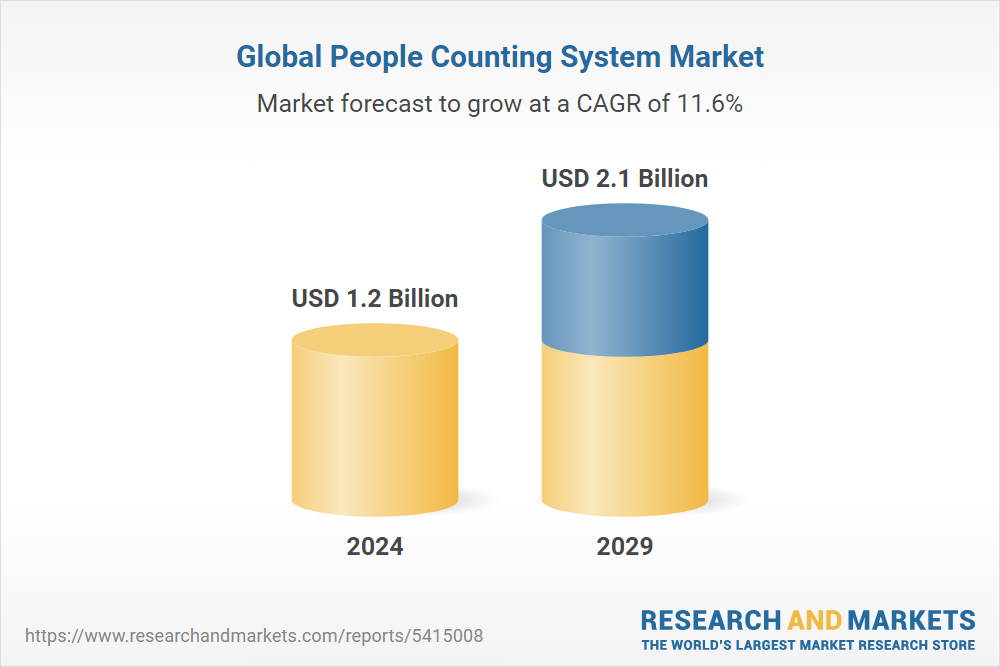
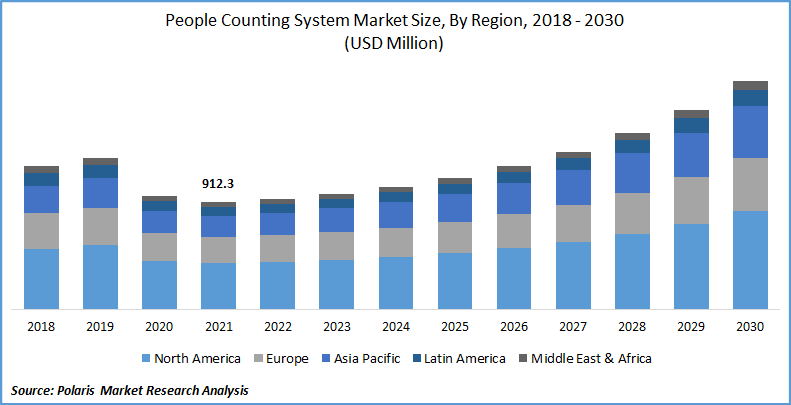
The retail sector is the largest adopter of people counting systems globally. The market for these systems is projected to grow to USD 2.1 billion by 2029, at a compound annual growth rate (CAGR) of 11.6%. The market is driven by major players such as RetailNext, Inc. (US), Sensormatic Solutions (US), CountWise (US), Teledyne Technologies Incorporated (US), and more.
Larger retail chains and big-box stores, such as Walmart, Kroger, and Costco in North America, are more likely to have adopted people counting systems than smaller, independent retailers and business owners. Market penetration is estimated between 30% and 50%, meaning approximately 300,000 to 500,000 US retail stores may have implemented such systems.
Problem Validation
Disclaimer: To validate the problem, I conducted one-on-one interviews and calls with retail store managers in Calgary. Since the data was collected verbally, I was unable to gather supporting survey statistics or produce informative graphs to back up the findings. However, I plan to provide this in the future.
Small to Medium-Sized Business inputs
They typically rely on historical observation to gauge peak hours, making them less inclined to invest in advanced foot traffic solutions. Their well-trained, cross-functional staff can manage any store zone dynamically during rush hours, and the absence of significant customer overflow (post-COVID) means there are no pressing concerns about occupancy limits.
Investment in improvement of people counting systems is often perceived as redundant, especially when they already have proxies such as sales data, employee observations, and customer feedback. As a result, most small and medium-sized businesses either don’t adopt people counting systems at all or rely on indirect data sources, which do not accurately capture potential lost customers. This reflects a general reluctance to invest in such solutions, particularly when the data they currently rely on is sufficient for their needs.
Large-Sized Business and Corporation (LMB) inputs
Most large retailers, theme parks, and malls already use automated people counting systems rather than manual clickers. These systems primarily capture the number of people entering and exiting at specific times and can map foot traffic patterns over time. Some of these businesses may even engage in “Advanced Behavioral & Sales Insights,” integrating foot traffic data with POS data to gain insights into customer behavior and sales trends, though this may not apply universally across all locations.
To gather more detailed insights, it could be valuable to engage directly with corporate-level decision-makers rather than store managers, who typically focus on daily operational concerns rather than on data-driven strategic impacts. Attending industry expos and networking events may also provide opportunities for open, informal discussions that yield more honest and impactful insights.
Final Verdict
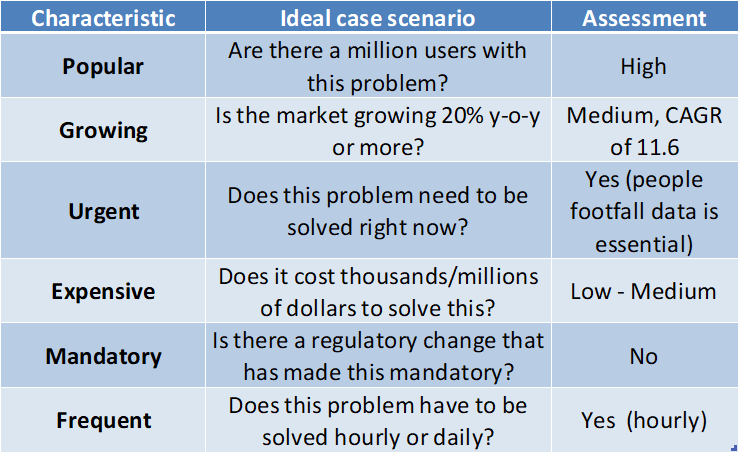
In conclusion, this is a popular, frequent and growing problem. Large businesses, such as big-box retailers and malls, value foot traffic tracking for strategic insights but aren’t actively seeking advanced options. Conversely, small to medium-sized businesses generally avoid investing in these systems, relying on direct observation and their staff’s knowledge of peak times. Future growth in advanced people-counting technology will likely be driven by large retail, grocery stores, and niche markets like luxury boutiques, where detailed customer insights are integral to business strategy.
The market for people-counting systems is projected to expand steadily to $2.1 billion USD by 2029, with a broad range of competitors offering different technologies. Despite the differences between the customer segments, we can confidently say that the analogy of website traffic data highlights the potential value of similar insights for physical stores. Overall, desirability and viability are medium, while feasibility remains high.
Therefore, this is a “Real Problem”. However, existing market competition and the lack of widespread customer interest (currently at 50% market penetration) in deploying advanced people-counting technologies put this in a unique position. It becomes clear that we do not need to focus on solving the primary issue of manual people counting, as technologies already exist to address it.
Instead, it is time to pivot and explore why these technologies are not widely adopted. The next step is to investigate the barriers to adoption, which may involve cost concerns, lack of perceived value, or safety concerns. Additionally, focusing on a niche market with specific needs, such as luxury retail or high-traffic venues, could unlock greater opportunities and differentiate the solution in an otherwise saturated market.
Niche pivot: People counting systems that leverage existing in-store technology (cameras) in the building while enforcing high standrads of data privacy and security by meeting global data privacy regulations like GDPR and CCPA helps stores build trust and stay legally compliant.
Possible niche solution: Using in-store cameras and AI models to provide customer traffic data to businesses. A Shameless Plug for Our MVP 😉😂(Made Back in Third Year of Uni).
See you in 10 days with a new problem and its validation!